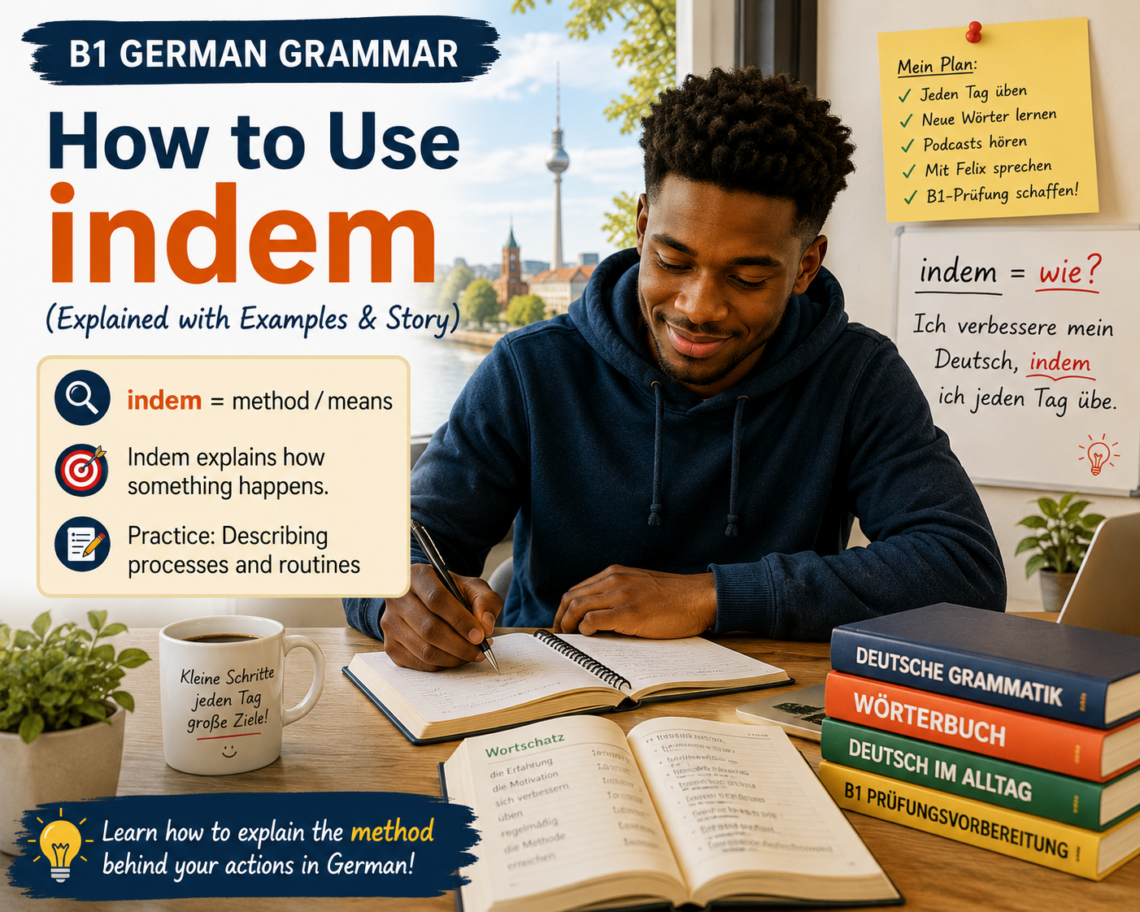
B1 German: How to Use „indem“ (Explained with Examples & Story)
July 7, 2026Share this lessonIntroduction In this lesson, you will learn how to use indem. Indem is used to explain how something happens or the method someone uses to achieve a goal. It is one of the most useful conjunctions at B1 level because it helps you describe: To make the grammar easier and more interesting, we will continue Tom’s story. 👉 Before reading this lesson, make sure you have read: 1. Using „indem“ We use indem to explain how something happens or the method someone uses to achieve a result. It answers the question: Wie? (How?) Structure Hauptsatz + indem +…
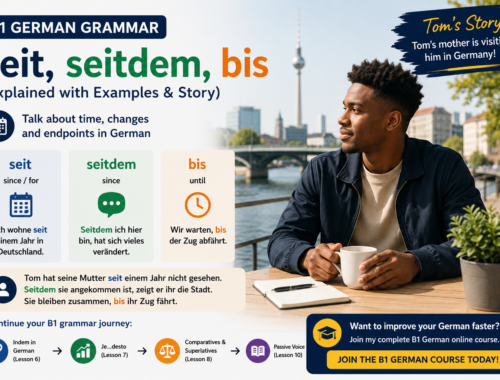
B1 German: How to Use „seit“, „seitdem“ and „bis“ (Explained with Examples & Story)
Share this lessonIntroduction In this lesson, you will learn how to use: These structures are useful when talking about: To make the grammar easier and more interesting, we will continue Tom’s story. 👉 Before reading this lesson, make sure you…
B1 German: Adjectives as Nouns & Present Participles (Explained with Examples & Story)
Share this lessonIntroduction In this lesson, you will learn how to use: These structures are very common in newspapers, formal German, books, and B1-level writing. To make the grammar easier and more interesting, we will continue Tom’s story. 👉 Before…
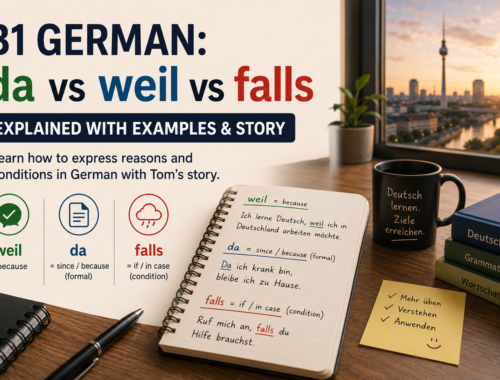
B1 German: da vs weil vs falls (Explained with Examples & Story)
Share this lessonIntroduction In this lesson, you will learn how to use: These conjunctions help you explain reasons, describe situations, and talk about conditions — all very important skills at B1 level. To make the grammar easier and more interesting,…
B1 German Grammar: wegen + Genitiv and trotz + Genitiv (Learn Through Story – Tom in Germany)
Share this lessonIntroduction At B1 level, learning German is not just about memorizing rules. It’s about understanding how people actually live, work, and communicate in real situations. In this lesson, you’ll learn how to express: But instead of isolated sentences,…
B1 German Grammar: Verbs with Prepositions & “da-Words” Explained (With Examples)
Share this lessonIntroduction One of the biggest challenges for learners at B1 level is using verbs with the correct prepositions. Many learners say:❌ Ich warte den BusBut in German, this is incorrect. The correct sentence is:✅ Ich warte auf den…
B1 German: How to Use “um…zu” and “ohne…zu” (With Examples & Exercises)
Share this lessonIntroduction If you want to speak German more naturally at B1 level, you must learn how to express goals and intentions. Two of the most important structures for this are: These structures are essential for B1 German exams…
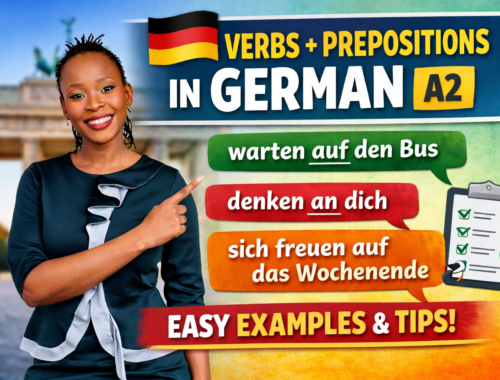
Verbs with Prepositions in German (A2): Simple Explanation and Examples
Share this lessonAt A2 level in German, you already know many basic verbs like gehen, machen, or lernen.But then you see sentences like: And suddenly, German feels more difficult. This happens because some verbs in German always need a preposition.In…
Talking About Health, Sport and Lifestyle in German (A2)
Share this lessonAt A2 level in German, learners begin to talk not only about daily routines, but also about health, sport, and lifestyle. This topic is important because it helps learners: In this guide, you will learn how to talk…
Giving Advice and Talking About Conditions in German (A2): wenn and sollte
Share this lessonAt A2 level, German learners move beyond simple statements.You don’t just say what you do — you also start to say: These two ideas are very common in everyday German: In this post, you will learn how to…
Talking About Your Job and Daily Work in German (A2)
Share this lessonAt A2 level, learners want to talk about more than just their name or country.A very important topic at this stage is work: your job, your daily tasks, and your routine at work. This topic is especially useful…